Part IV: The Seige
When Titus took command of the Judean campaign in AD 70, he had at his disposal one of the most formidable military forces ever assembled. Four full legions: the V Macedonica, XII Fulminata, XV Apollinaris, and X Fretensis. Each legion comprised about 5,000 to 6,000 heavy infantry, supported by auxiliary units of cavalry, archers, and light infantry drawn from throughout the empire. Total force: somewhere between 60,000 and 80,000 men.
The Roman military machine was the most sophisticated in the ancient world. These weren't conscripts or militia—they were professional soldiers, extensively trained in formation fighting, siege warfare, and engineering. They could construct elaborate siege works—ramps, towers, battering rams—with remarkable speed and efficiency. Roman military doctrine emphasized systematic, methodical approaches to warfare. Don't take unnecessary risks. Apply overwhelming force at decisive points. Grind down the enemy's will to resist.
Titus's strategy for Jerusalem reflected this doctrine perfectly. He didn't attempt a direct assault on the heavily fortified city. Instead, he established a complete blockade, cutting off all supplies and escape routes. Then he systematically reduced Jerusalem's defenses, breaching one wall after another, constricting the defenders into smaller and smaller areas while starvation, disease, and demoralization did their work.
To be fair to the defenders, Jerusalem's defensive position was formidable. The city was protected by three concentric walls on its northern side, where the terrain was most vulnerable. The southern, eastern, and western sides were protected by steep valleys—the Kidron Valley to the east, the Hinnom Valley to the south and west—which made assault from those directions extremely difficult.
The outermost (third) wall, built by Herod Agrippa I in the 40s AD, enclosed the northern suburbs. The second wall protected the commercial district and the lower city. The first wall, the oldest and strongest, protected the upper city and the Temple Mount. The Temple Mount itself was essentially a fortress within the city, with massive retaining walls and limited access points.
The defenders had prepared for siege. They'd stockpiled weapons and, initially, substantial food supplies. The Temple treasury provided financial resources. The population included many experienced fighters—veterans of the earlier campaigns in Galilee, refugees from other conquered cities who had military experience. The factional leaders—John of Gischala, Simon bar Giora, and Eleazar ben Simon—were capable commanders who had proven themselves in previous engagements.
But Jerusalem's defenses were fatally compromised by internal divisions. The three main factions controlled different parts of the city and fought each other almost as fiercely as they fought the Romans. This internal conflict destroyed food supplies, killed experienced leaders, and prevented coordinated defensive strategies. When the Romans attacked, the defenders often had to fight on two fronts—against the Romans outside and against rival Jewish factions inside.
The Siege Progresses: April to August AD 70
April - Breaching the Third Wall: Titus began by establishing camps around the city and constructing siege works opposite the third wall. The defenders made several sorties to disrupt this work, sometimes successfully. But Roman engineering and numerical superiority prevailed. After fifteen days of battering, the Romans breached the third wall and poured into the northern suburbs. The defenders retreated to the second wall.
May - The Second Wall Falls: The second wall proved tougher. It was older, stronger, and the defenders fought desperately to hold it. The Romans breached it after four days of battering, but the defenders counterattacked and actually drove them out. It took three more days of fighting before the Romans finally secured the second wall. The defenders retreated to the Temple Mount and the upper city, where the siege entered its most brutal phase.
May-June - The Circumvallation: Recognizing that direct assault on the remaining fortifications would be costly, Titus decided to starve the defenders into submission. He ordered the construction of a circumvallation—a siege wall completely encircling Jerusalem to prevent any escape or resupply. This wall, approximately five miles long and studded with thirteen forts, was completed in just three days. Three days! It's a testament to Roman engineering capabilities and the size of Titus's workforce.
The circumvallation had devastating effects. No food could enter the city. No one could escape. The famine intensified dramatically. Josephus describes people eating leather, grass, eventually resorting to cannibalism. Bodies piled up in the streets. Disease spread rapidly in the crowded, unsanitary conditions. The defenders' strength ebbed as starvation took its toll.
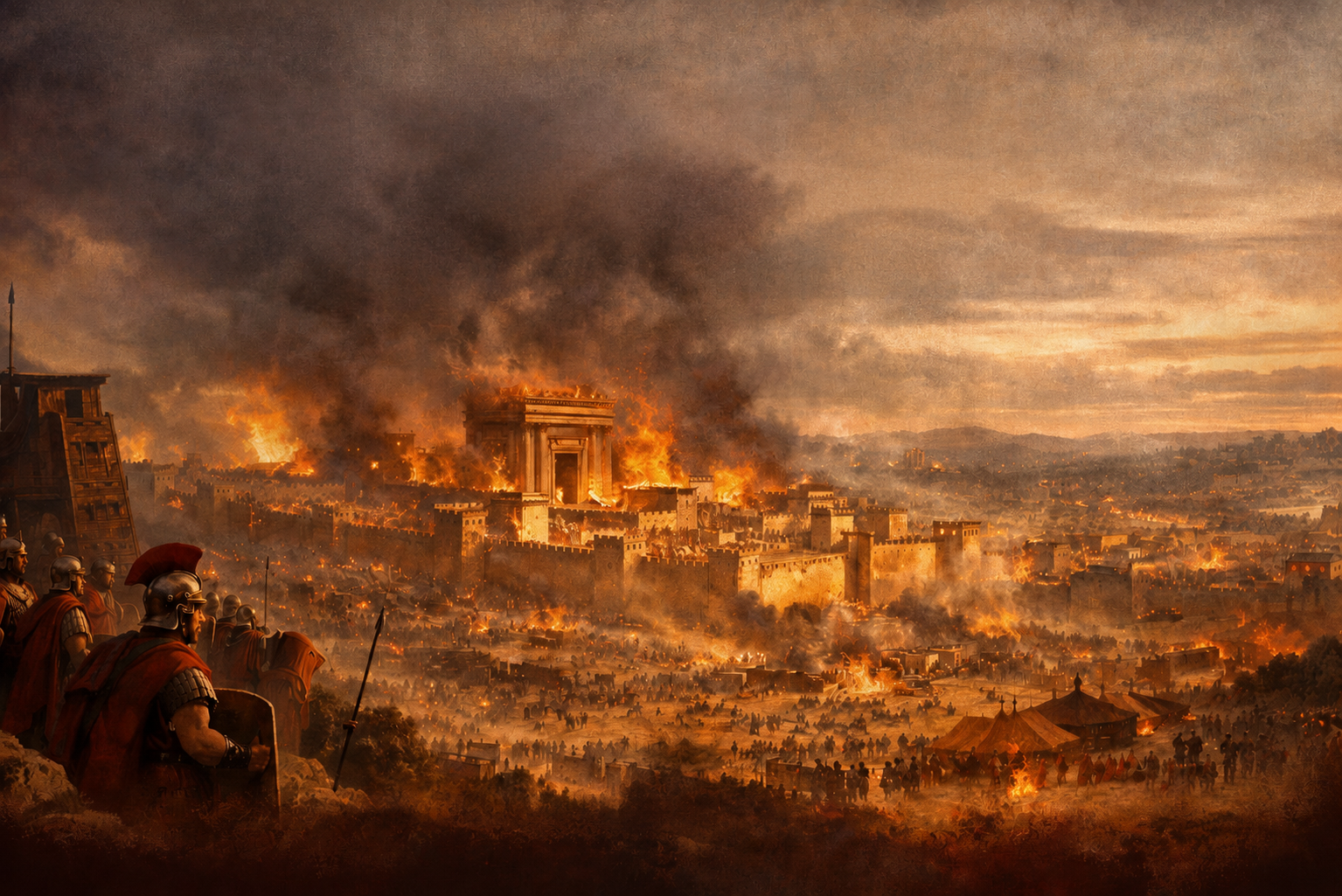
July - Assault on the Antonia Fortress: After allowing the famine to weaken the defenders, Titus resumed active operations in July. His target was the Antonia Fortress, a stronghold adjacent to the Temple Mount that provided access to the Temple complex. The Romans constructed massive earthen ramps to bring siege towers and battering rams to bear on the fortress walls.
The defenders, despite their weakened condition, fought with desperate courage. They tunneled under the Roman ramps and set fires that caused the ramps to collapse, destroying weeks of Roman work. But Roman persistence eventually prevailed. On July 24, Roman soldiers scaled the walls of the Antonia Fortress at night and overwhelmed the defenders. The fortress fell, giving the Romans a foothold on the Temple Mount itself.
The Temple's Destruction: August AD 70
With the Antonia Fortress secured, the Romans began their assault on the Temple itself. This phase of the siege was particularly intense. The Temple wasn't just a military stronghold—it was the spiritual heart of Judaism. The defenders fought with fanatical determination to protect it.
According to Josephus, Titus initially wanted to preserve the Temple. He recognized its magnificence and understood that capturing it intact would bring prestige. He ordered his soldiers to extinguish fires and avoid unnecessary destruction. But the intensity of the fighting and the defenders' determination made this impossible.
When Jesus told his discriples that the Temple would be destroyed, leaving not one stone upon another, it was hard to imagine the giant stone building being damaged much less destroyed stone by stone. Some of those stones weighed tons.
The Temple that stood on Mount Moriah in AD 70 was, according to Josephus, one of the most magnificent structures in the ancient world. Herod the Great had rebuilt it starting in 20 BC, transforming Solomon's modest structure into something that took your breath away. Even after Herod's death, construction continued for decades. Workers were still adding finishing touches when the revolt began.
Imagine approaching Jerusalem from the east, the morning sun at your back. The first thing that would strike you—before you even reached the city walls—was the gleam. The Temple's roof was covered in gold plates, and when the sun hit them, the whole structure blazed like a mountain of fire. Josephus said that from a distance, it looked like a snow-covered mountain because of the brilliant white marble, except where the gold caught the light.
The Temple complex covered about 35 acres—roughly 25 football fields. Massive retaining walls, some with stones weighing over 100 tons, supported the platform. The outer wall stood over 150 feet high in places. You entered through one of several gates into the Court of the Gentiles, a vast open space where anyone could come. Merchants sold sacrificial animals. Money changers exchanged Roman coins for Temple currency. Pilgrims from across the Mediterranean world gathered here.
But the real magnificence lay beyond. Past the Court of the Gentiles, a stone barrier marked the boundary that Gentiles could not cross, on pain of death. Beyond that, the Court of the Women, then the Court of the Israelites, each more restricted, each more sacred. And at the heart of it all stood the Temple building itself—the Sanctuary.
The Sanctuary was a structure of white marble and gold, about 150 feet long, 150 feet high. Its facade was covered in gold plates that gleamed in the sun. Inside, the Holy Place contained the golden altar of incense, the table of showbread, and the great menorah—the seven-branched lampstand of pure gold. Beyond a thick veil lay the Holy of Holies, the most sacred space in Judaism, empty except for the presence of God himself. Only the High Priest could enter, and only once a year, on Yom Kippur.
The smell of incense and roasting meat filled the air constantly. The sound of prayers, of rams' horns, of thousands of worshippers. This wasn't just a building—it was the place where heaven touched earth, where God dwelt among his people.
This was what the Romans were about to destroy.
On August 29 or 30 (the exact date is debated), the Temple was set ablaze. Josephus provides two accounts of how it happened. In one version, a Roman soldier, acting against orders, threw a burning torch through a window, igniting the wooden interior structures. In another account, the defenders themselves set fires to prevent the Romans from capturing the Temple intact. Regardless of how it started, the fire quickly spread through the Temple complex.
The destruction was total. The intense heat melted the gold decorations, which flowed into the cracks between stones. Roman soldiers later pried apart the stones to recover the gold, physically fulfilling Jesus's prophecy that "not one stone will be left upon another." The sacred vessels—the menorah, the table of showbread—were taken as spoils and later displayed in Titus's triumph in Rome. The Arch of Titus, still standing in Rome today, depicts Roman soldiers carrying these sacred objects.
The Temple's destruction marked a turning point in Jewish history. The sacrificial system, which had been central to Jewish worship for a millennium, came to an abrupt end. The priesthood lost its primary function. Judaism would have to reinvent itself, transforming from a Temple-centered religion to one focused on Torah study, prayer, and synagogue worship—a transformation led by the Pharisaic rabbis who survived the catastrophe.
The Final Assault: September AD 70
With the Temple destroyed, only the upper city remained in rebel hands. Simon bar Giora and John of Gischala, the surviving factional leaders, continued to resist from the palaces and fortifications of the upper city. But their position was hopeless. The Romans constructed new siege ramps and brought their engines to bear on the remaining walls.
On September 26, the Romans breached the walls of the upper city. What followed was a massacre.
Roman soldiers, enraged by the long siege and the loss of comrades, showed no mercy. They killed indiscriminately, slaughtering combatants and non-combatants alike. The streets ran with blood. Josephus describes the Romans as wading through corpses, the city so filled with dead that there was no room to walk without stepping on bodies.
The Romans systematically demolished Jerusalem's fortifications, leaving only three towers—Phasael, Hippicus, and Mariamne—as monuments to the city's former strength and to demonstrate what Roman power had overcome. The rest of the city was razed. Titus ordered that Jerusalem be plowed under, leaving almost no trace of the once-magnificent city.
The Aftermath and Casualties
The human cost was staggering. Josephus claims 1.1 million people died during the siege, though modern historians consider this figure exaggerated, likely inflated for dramatic effect or based on unreliable estimates. More conservative scholarly estimates suggest 200,000 to 400,000 deaths—still an unprecedented catastrophe for the ancient world.
Approximately 97,000 survivors were taken captive, according to Josephus. Their fates varied, and none of them were good. Some were sent to work in Egyptian mines—essentially a death sentence. Others were distributed throughout the empire to die in gladiatorial games or be executed in public spectacles. Young men of particular physical beauty were reserved for Titus's triumph in Rome. Children were sold into slavery. The elderly and infirm were simply killed as having no value.
The leaders of the revolt met different ends. Simon bar Giora was captured and taken to Rome, where he was executed during Titus's triumph, thrown from the Tarpeian Rock in the traditional manner for enemies of Rome. John of Gischala was captured and sentenced to life imprisonment. Eleazar ben Simon had been killed earlier in the factional fighting. The high priest and other religious leaders were executed.
The destruction of Jerusalem in AD 70 marked the effective end of the Jewish revolt, though pockets of resistance continued. The fortress of Masada held out until AD 73, when its defenders committed mass suicide rather than surrender to Rome. The revolt had been a catastrophe for the Jewish people—massive loss of life, the destruction of the Temple, the end of the sacrificial system, and the beginning of a diaspora that would last for nearly two millennia.
The End of the Temple Era
The destruction of the Temple in AD 70 was a watershed moment in religious history, with profound implications for both Judaism and Christianity.
For Judaism, it necessitated a complete reimagining of religious practice and identity. The Temple had been the center of Jewish worship for a millennium—the place where God's presence dwelt among his people, where sacrifices atoned for sin, where the great festivals were celebrated. Its destruction forced Judaism to transform from a Temple-centered, sacrificial religion to one focused on Torah study, prayer, and ethical living.
The Pharisaic rabbis became the architects of this new Judaism. According to tradition, a rabbi named Yohanan ben Zakkai escaped Jerusalem during the siege (supposedly smuggled out in a coffin) and established an academy at Yavneh. These rabbis reinterpreted Temple rituals as prayers, transformed the home into a miniature sanctuary, and elevated Torah study to the highest form of worship. This rabbinic Judaism would become the foundation for all subsequent Jewish tradition.
For Christianity, the Temple's destruction provided powerful confirmation of Jesus's prophetic authority and messianic identity. Jesus had predicted the Temple's destruction in vivid detail, and the fulfillment of this prophecy within the lifetime of his disciples strengthened Christian claims about his divine mission. The destruction also reinforced Christian theological claims that Jesus's death had superseded the Temple sacrificial system, that his body was the true temple, and that worship was no longer tied to a specific geographic location. Having fled before the siege began, they spread through out the Roman kingdom.
The early Christian community interpreted AD 70 through the lens of covenant theology. The destruction represented God's judgment on the old covenant system and confirmed the establishment of the new covenant inaugurated by Jesus. The author of Hebrews, writing either shortly before or after AD 70, extensively develops the theme that Jesus's sacrifice had made the Temple system obsolete. The destruction of the physical Temple seemed to confirm this theological argument in the most dramatic way possible.